Department of Food Science and Technology, Faculty of Science, Kyambogo University, Kampala, Uganda , ogwokp@yahoo.com
Abstract: (556 Views)
Background and Objectives: Tea quality and safety are global challenges. This study assessed the quality and safety of green and black teas locally consumed in Uganda by analyzing proximate components (moisture, fat, protein, ash, fiber, and carbohydrate), as well as vital and harmful elements, and polyphenol and flavonoid levels.
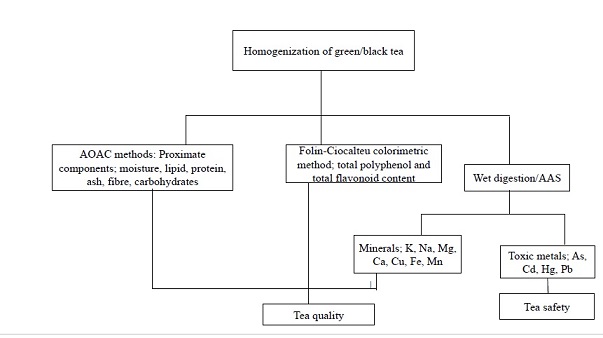
Materials and Methods: Proximate components were determined using standardized methods developed by the Association of Official Analytical Chemists. Chemical elements were analyzed using Atomic Absorption Spectrophotometry. Total polyphenol content was quantified using the standard Folin-Ciocalteu assay. The total flavonoid content was determined using the aluminum chloride colorimetric assay.
Results: The tea components ranged from 2.64to 8.43, 0.87 to 3.74, 12.41 to 29.28, 4.34 to 9.08, 12.12 to 31.46, and 28.65 to 61.13%, for moisture, fat, protein, ash, crude fiber, and carbohydrate, respectively. Metal concentrations (mg/kg) ranged from 694.95 to 2681.83, 4.53 to 11.77, 17.51 to 32.59, 47.60 to 141.17, 39.77 to 280.94, 1.18 to 2.28, and 8.30 to 37.69 correspondingly for potassium, sodium, magnesium, manganese, calcium, copper and iron. All tea samples contained no detectable levels of lead, arsenic, cadmium and mercury. Green and black tea contained 82.17 to 159.31 mg of total polyphenols per gram of dry weight, measured in gallic acid equivalents, and 122.12 to 183.24 mg of total flavonoids per gram of dry weight, measured in rutin equivalents.
Conclusion: Tea in Uganda is of good quality and generally safe for human consumption. Green tea can be considered a nutrient-rich food due to its high content of polyphenols and minerals, which provide antioxidant, anti-inflammatory, and anticancer benefits.
Recommendations: Lead, arsenic, cadmium, and mercury levels in both green and black tea were below internationally set limits, making the teas safe to consume. Green tea can be preferred over black tea for its higher antioxidant benefits due to minimal oxidation, which preserves its polyphenols. A comprehensive evaluation of the teas’ antioxidant capacity is recommended to get complete and thorough knowledge of their capacity to scavenge free radicals and reduce oxidative stress.
The moisture and ash contents were within internationally recommended limits.
Green and black tea can supplement the diet with vital minerals such as potassium, magnesium, and manganese.
References
1. Phong NH, Pongnak W, Soytong K, Poeaim S, Poeaim A. Diversity of tea (Camellia sinensis) grown in Vietnam based on morphological characteristics and inter-primer binding sites (iPBS) marker. International Journal of Agriculture and Biology. 2016; 18(2): 385-392. [DOI:10.17957/IJAB/15.0100]
2. Jayasinghe SL, Kumar L. Potential impact of the current and future climate on the yield, quality, and climate suitability for tea (Camellia sinensis (L.) O. Kuntze): A systematic review. Agronomy. 2021; 11: 619. [DOI:10.3390/agronomy11040619]
3. Kawooya R. Accomplishments of Tea Research in Uganda in the Year 2019. European Journal of Agriculture and Food Sciences. 2021; 3(1): 75-78. [DOI:10.24018/ejfood.2021.3.1.214]
4. Kosińska A, Andlauer W. Antioxidant capacity of tea: Effect of processing and storage. Dan's processing and impact on antioxidants in beverages. 2014; 109-120. [DOI:10.1016/B978-0-12-404738-9.00012-X]
5. Zhang L, Ho CT, Zhou J, Santos JS, Armstrong L, Granato D. Chemistry and biological activities of processed camellia sinensis teas: A comprehensive review. Comprehensive Reviews in Food Science and Food Safety. 2019; 18: 1474-1495. [DOI:10.1111/1541-4337.12479]
6. Yadav KC, Parajuli A, Khatri BB, Shiwakoti LD. Phytochemicals and quality of green and black teas from different clones of tea plant. Journal of Food Quality. 2018.
7. Pongrac P, Tolrà R, Hajiboland R, Vogel-Mikuš K, Kelemen M, Vavpetič P, Poschenrieder C. Contrasting allocation of magnesium, calcium and manganese in leaves of tea (Camellia sinensis (L.) Kuntze) plants may explain their different extraction efficiency into tea. Food and Chemical Toxicology. 2020; 135. [DOI:10.1016/j.fct.2019.110974]
8. Zhang J, Yang R, Chen R, Li YC, Peng Y, Liu C. Multielemental analysis associated with chemometric techniques for geographical origin discrimination of tea leaves (Camelia sinensis) in Guizhou Province, SW China. Molecules. 2018; 23. [DOI:10.3390/molecules23113013]
9. Xu C, Liang L, Li Y, Yang T, Fan Y, Mao X et al. Studies of quality development and major chemical composition of green tea processed from tea with different shoot maturity. LWT - Food Science and Technolog. 2021; 142: 111055. [DOI:10.1016/j.lwt.2021.111055]
10. Nibir YM, Sumit AF, Akhand AA, Ahsan N, Hossain MS. Comparative assessment of total polyphenols, antioxidant and antimicrobial activity of different tea varieties of Bangladesh. Asian Pacific Journal of Tropical Biomedicine. 2017; 7(4): 352-357. [DOI:10.1016/j.apjtb.2017.01.005]
11. Sik B, Székelyhidi R, Lakatos E, Kapcsándi V, Ajtony Z. Analytical procedures for determination of phenolic active herbal ingredients in fortified functional foods: an overview. European Food Research and Technology. 2022; 248: 329-344. [DOI:10.1007/s00217-021-03908-6]
12. Dmowski P, Ruszkowska M. Equilibrium moisture content importance in safe maritime transport of black tea. International Journal on Marine Navigation and Safety of Sea Transportation. 2018; 12(2): 399-404. [DOI:10.12716/1001.12.02.22]
13. Abbasi E, Yousefi MH, Hashemi S, Hosseinzadeh S, Ghadimi AH, Safapour M et al. Aflatoxin B1 and heavy metals in imported black tea to Bushehr, southern Iran; Contamination rate and risk assessment. Journal of Food Composition and Analysis. 2022; 106. [DOI:10.1016/j.jfca.2021.104277]
14. Chen P, Bornhorst J, Aschne M. Manganese metabolism in humans. Frontiers in Bioscience.2018; 23(9): 655-679. [DOI:10.2741/4665]
15. Ramdani D, Chaudhry AS, Seal CJ. Chemical composition, plant secondary metabolites, and minerals of green and black teas and the effect of different tea-to-water ratios during their extraction on the composition of their spent leaves as potential additives for ruminants. Journal of Agricultural and Food Chemistry. 2013; 61(20): 4961-4967. [DOI:10.1021/jf4002439]
16. Pradhan S, Dubey RC. Proximate analysis, total phenolic content, antioxidant activity and anti-diabetic properties of Camellia sinensis and Camellia assamica. Biochemical and Cellular Archives.2020; 20(1): 15-23.
17. Wong M, Sirisena S, Ng K. Phytochemical profile of differently processed tea: A review. Journal Food Science. 2022; 87: 1925-1942. [DOI:10.1111/1750-3841.16137]
18. Malongane F, McGaw LJ, Mudau FN. Chemical compositions and mineral content of four selected South African herbal teas and the synergistic response of combined teas. British Food Journal. 2020; 122(9): 2769-2785. [DOI:10.1108/BFJ-07-2019-0568]
19. Adnan M, Ahmad A, Ahmed A. Chemical composition and sensory evaluation of tea (Camellia sinensis) commercialized in Pakistan. Pakistani Journal of Botany.2013; 45(3): 901-907.
20. ISO 2011a, ISO 3720: 2011. Black tea - Definition and basic requirements. International Organization for Standardization, Geneva, Switzerland.
21. Shevchuk A, Megías-Pérez R, Zemedieand Y, Kuhnert N. Evaluation of carbohydrates and quality parameters in six types of commercial teas by targeted statistical analysis. Food Research International. 2020; 133: 109122. [DOI:10.1016/j.foodres.2020.109122]
22. Lv Q, Long J, Gong Z, Nong K, Liang X, Qin T, et al. Current state of knowledge on the antioxidant effects and mechanisms of action of polyphenolic compounds. Natural Product Communications. 2021; 16(7): 1-13. [DOI:10.1177/1934578X211027745]
23. Bobková A, Demianová A, Belej L, Harangozo L, Bobko M, Jurˇcaga L. et al. Detection of changes in total antioxidant capacity, the content of polyphenols, caffeine, and heavy metals of teas in relation to their origin and fermentation. Foods. 2021; 10: 1821. [DOI:10.3390/foods10081821]
24. Bamuwamye M, Ogwok P, Tumuhairwe V, Eragu R, Nakisozi H, Ogwang PE. Dietary content and potential health risks of metals in commercial black tea in Kampala (Uganda). Journal of Food Research. 2017; 6(6): 1-12. [DOI:10.5539/jfr.v6n6p1]
25. Fernández-Cáceres PL, Martín MJ, Pablos F, González AG. Differentiation of tea (Camellia sinensis) varieties and their geographical origin according to their metal content. Journal of Agricultural and Food Chemistry. 2001; 49(10): 4775-4779. [DOI:10.1021/jf0106143]
26. Islam MA, Ebihara M. Elemental characterization of Japanese green tea leaves and tea infusion residue by neutron-induced prompt and delayed gamma-ray analysis. Arabian Journal of Chemistry. 2017; 10(1): 677-682. [DOI:10.1016/j.arabjc.2012.11.008]
27. Pravina P, Sayaji D, Avinash M. Calcium and its role in the human body. International Journal of Research in Pharmaceutical and Biomedical Sciences. 2013;4(2): 659-668.
28. Al-Alawi AM, Majoniand SW, Falhammar H. Magnesium and human health: Perspectives and research directions. International Journal of Endocrinology. 2018; 9041694. [DOI:10.1155/2018/9041694]
29. Taranto F, Pasqualone A, Mangini G, Tripodi P, Miazzi MM, Pavan S. et al. Polyphenol oxidases in crops: Biochemical, physiological and genetic aspects. International Journal of Molecular Sciences. 2017; 18(2): 377. [DOI:10.3390/ijms18020377]
30. Bost M, Houdart S, Oberli M, Kalonji E, Huneau JF, Margaritis I. Dietary copper and human health: Current evidence and unresolved issues. Journal of Trace Elements in Medicine and Biology. 2016; 35: 107-115. [DOI:10.1016/j.jtemb.2016.02.006]
31. Karakand T, Bhagat M. Trace elements in tea leaves, made tea and tea infusion: A review. Food Research International. 2010;43(9):2234-2252. [DOI:10.1016/j.foodres.2010.08.010]
32. Nyarko-Danquah I, Pajarillo E, Digman A, Soliman KF, Aschner M, Lee E. Manganese accumulation in the brain via various transporters and its neurotoxicity mechanisms. Molecules. 2020; 25(24): 5880. [DOI:10.3390/molecules25245880]
33. Jurowski K, Kondratowicz Pietruszka E, Krośniak M. The control and comprehensive safety assessment of heavy metal impurities (As, Pb, and Cd) in green Tea Camellia sinensis (L.) samples (infusions) available in Poland. Biological Trace Element Research. 2024; 20(2): 387-396. [DOI:10.1007/s12011-023-03665-5]
34. ISO 11287: 2011 Green tea - Definition and basic requirements. International Organization for Standardization, Geneva, Switzerland. 2011b.
35. Tong T, Liu YJ, Kang J, Zhangand CM, Kang SG. Antioxidant activity and main chemical components of a novel fermented tea. Molecules. 2019; 24: 2917. [DOI:10.3390/molecules24162917]
36. Kiyimba T, Yiga P, Bamuwamye M, Ogwok P, Schueren BV, Matthys C. Efficacy of dietary polyphenols from whole foods and purified food polyphenol extracts in optimizing cardiometabolic health: A Meta-Analysis of randomized controlled trials. Advances in Nutrition. 2023; 14(11). [DOI:10.1016/j.advnut.2023.01.002]
37. Tanaka T, Matsuo Y. Production mechanisms of black tea polyphenols. Chemical and Pharmaceutical Bulletin. 2020;l(12): 1131-1142. [DOI:10.1248/cpb.c20-00295]