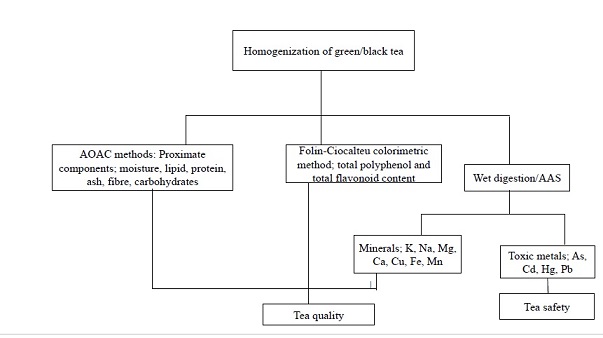
Background and Objectives: Tea quality and safety are global challenges. This study assessed the quality and safety of green and black teas locally consumed in Uganda by analyzing proximate components (moisture, fat, protein, ash, fiber, and carbohydrate), as well as vital and harmful elements, and polyphenol and flavonoid levels.
Materials and Methods: Proximate components were determined using standardized methods developed by the Association of Official Analytical Chemists. Chemical elements were analyzed using Atomic Absorption Spectrophotometry. Total polyphenol content was quantified using the standard Folin-Ciocalteu assay. The total flavonoid content was determined using the aluminum chloride colorimetric assay.
Results: The tea components ranged from 2.64 to 8.43, 0.87 to 3.74, 12.41 to 29.28, 4.34 to 9.08, 12.12 to 31.46, and 28.65 to 61.13%, for moisture, fat, protein, ash, crude fiber, and carbohydrate, respectively. Metal concentrations (mg/kg) ranged from 694.95 to 2681.83, 4.53 to 11.77, 17.51 to 32.59, 47.60 to 141.17, 39.77 to 280.94, 1.18 to 2.28, and 8.30 to 37.69 correspondingly for potassium, sodium, magnesium, manganese, calcium, copper and iron. All tea samples contained no detectable levels of lead, arsenic, cadmium and mercury. Green and black tea contained 82.17 to 159.31 mg of total polyphenols per gram of dry weight, measured in gallic acid equivalents, and 122.12 to 183.24 mg of total flavonoids per gram of dry weight, measured in rutin equivalents.
Conclusion: Tea in Uganda is of good quality and generally safe for human consumption. Green tea can be considered a nutrient-rich food due to its high content of polyphenols and minerals, which provide antioxidant, anti-inflammatory, and anticancer benefits.
Recommendations: Lead, arsenic, cadmium, and mercury levels in both green and black tea were below internationally set limits, making the teas safe to consume. Green tea can be preferred over black tea for its higher antioxidant benefits due to minimal oxidation, which preserves its polyphenols. A comprehensive evaluation of the teas’ antioxidant capacity is recommended to get complete and thorough knowledge of their capacity to scavenge free radicals and reduce oxidative stress. |