Mitra S.K. Private Limited, Shrachi Centre (5th Floor), Kolkata – 700 016, India & Department of Food Technology and Biochemical Engineering, Jadavpur University, Kolkata- 700032, India , debalina.kundu@mitrask.in
Abstract: (770 Views)
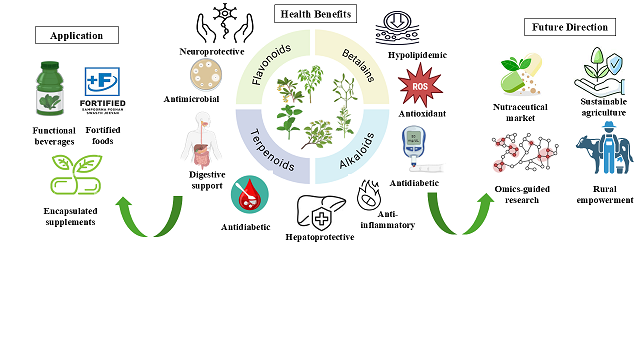
Underutilized edible leafy herbs form a critical yet often overlooked component of Indian diets and traditional medicine, offering a potent source of phytonutrients with diverse health benefits. This review evaluates eight such herbs Moringa oleifera, Amaranthus viridis, Trigonella foenum-graecum, Solanum nigrum, Murraya koenigii, Mentha spicata, Basella alba, and Ipomoea aquatica, focusing on their phytochemical profiles, pharmacological potential, and functional food applications. These species are rich in flavonoids, alkaloids, terpenoids, betalains, and saponins that exhibit antioxidant, antidiabetic, anti-inflammatory, hepatoprotective, and antimicrobial effects. Nutraceutical innovations, including nanoencapsulation, high-resolution metabolomic profiling (LC-MS, NMR), and green extraction methods, have enhanced the bioavailability and stability of these phytoconstituents. Despite strong in vitro and preclinical evidence, clinical trials and standardization protocols remain limited. This review identifies key research gaps and advocates for omics-integrated, sustainability-focused strategies to promote these herbs as climate-resilient, low-input crops for dietary diversification, nutrition security, and functional food development. The findings provide a roadmap to integrate Indian leafy greens into modern nutritional frameworks while preserving ethnobotanical heritage.
Evaluates eight underutilized Indian leafy herbs for their phytochemical diversity and therapeutic applications.
Highlights bioactivities such as antioxidant, antidiabetic, hepatoprotective, and neuroprotective effects.
Discusses omics-integrated strategies, nanoencapsulation, and green extraction for enhancing nutraceutical efficacy.
Identifies research gaps in clinical validation, standardization, and bioavailability.
Promotes these herbs as climate-resilient crops for sustainable nutrition and food security.
References
1. Kim YS, Hahn EJ, Murthy HN, Paek KY (2004) Adventitious root growth and ginsenoside accumulation in Panax ginseng cultures as affected by methyl jasmonate. Biotechnol Lett. 26(21):1619-22. https://10.1007/s10529-004-3183-2. PMID: 15604808. [DOI:10.1007/s10529-004-3183-2]
2. Patra S, Shand H, Manna A, Bose D, Some S, Mondal R (2024) Ethnopharmacological and nutritional insights into wild leafy vegetables: implications for food security, nutraceutical potential, and environmental remediation. Discov Plants 1, 56 . [DOI:10.1007/s44372-024-00053-8]
3. Sarkar U, Oba S (2023) Bioactive phytochemicals and antioxidant activity in selected Amaranthus leafy vegetables. Sci Rep 13:134. [DOI:10.1038/s41598-022-27145-6]
4. Ahmed D, Sharma S, Sharma A (2021) Phytochemical investigation and pharmacological potential of Moringa oleifera: a mini-review. J Ethnopharmacol 276:113835. [DOI:10.1016/j.jep.2021.113835]
5. Rawson A, Tiwari BK, Tuohy MG, O'Donnell CP, Brunton N (2011) Effect of ultrasound and blanching pretreatments on polyacetylene and polyphenolic content of hot water extracts from fennel. Food Bioprocess Technol 4:80-88. [DOI:10.1007/s11947-009-0309-1]
6. Deepali D, Gulia V, Dhull SS, Beniwal D, Rani J, Abdi G (2025) Unveiling Moringa oleifera: potent source of antioxidant and antibacterial properties. Discov Appl Sci 7, 381. [DOI:10.1007/s42452-025-06836-2]
7. Hassan MA, Xu T, Tian Y, Zhong Y, Ali FAZ, Yang X, Lu B (2021) Health benefits and phenolic compounds of Moringa oleifera leaves: A comprehensive review. Phytomedicine. 93:153771. https://10.1016/j.phymed.2021.153771 [DOI:10.1016/j.phymed.2021.153771]
8. Chidambaram R, Chidambaram S, Natarajan N (2022) Toxicological assessment of glycoalkaloids from Solanum species. Phytother Res 36:255-263. [DOI:10.1002/ptr.7331]
9. Elizalde-Romero CA, Gomez-Angulo C, Tzintzun-Camacho O et al (2021) Hepatoprotective activity of Solanum nigrum against CCl₄-induced liver injury. BMC Complement Med Ther 21:120. [DOI:10.1186/s12906-021-03286-3]
10. Karthika R, Rajan S, Divya P (2022) Phytotherapeutic value of Basella alba: a review on nutritional and medicinal aspects. J Ethnopharmacol 283:114667. [DOI:10.1016/j.jep.2021.114667]
11. Mahajan V, Mali R, Choudhary R (2023) The anticancer potential of chemical constituents of Moringa oleifera: a systematic review. BMC Complement Med Ther 23:22. [DOI:10.1186/s12906-023-04198-z]
12. Popoola JO, Aworunse OS, Oyesola LO, Akinnola OO, Obembe OO (2020) A review of phytochemical and pharmacological studies of Moringa oleifera. J Herbmed Pharmacol 9(3):174-190. [DOI:10.34172/jhp.2020.24]
13. Peter J, Gandhi P (2017) Evaluation of Amaranthus viridis for antioxidant and hepatoprotective activity. Int J Pharm Sci Rev Res 42:152-157
14. Nkobole N, Prinsloo G (2021) 1H-NMR and LC-MS-based metabolomics analysis of wild and cultivated Amaranthus species. Molecules 26(4):795. [DOI:10.3390/molecules26040795]
15. Rajalakshmi M, Sethuraman MG (2023) Fenugreek seed extract-based formulation for diabetes management: A preclinical study. J Food Biochem 47:e14226. [DOI:10.1111/jfbc.14226]
16. Bodiga VL, Vemuri PK, Bodiga S (2021) Neuroprotective effects of fenugreek extract via acetylcholinesterase inhibition. Biomed Res Int 2021:5523430. [DOI:10.1155/2021/5523430]
17. Gupta N, Sharma SK, Sreerama L et al (2021) Synergistic effects of turmeric and fenugreek on oxidative stress markers in metabolic syndrome: a preclinical study. Int J Food Sci Nutr 72(7):905-913. [DOI:10.1080/09637486.2021.1882051]
18. Chen Y, Long H, Deng J et al (2022) Solanum nigrum L. induces apoptosis and cell cycle arrest in liver cancer cells through mitochondrial and PI3K/Akt pathways. J Ethnopharmacol 284:114778. [DOI:10.1016/j.jep.2021.114778]
19. Handral HK, Pandith A, Shruthi SD (2012) A review on Murraya koenigii: multipotential medicinal plant. Asian J Pharm Cln. Res 5(4):5-14.
20. Dinesh R, Singh AK, Verma SK (2023) Carbazole alkaloids from Murraya koenigii: a review of chemistry and biological activities. J Pharm Biol Sci 18(2):112-120. [DOI:10.9790/3008-180203112120]
21. Rajkumar T, Singhal K, Lamba N, Sharma M (2024) Therapeutic implications of Murraya koenigii in metabolic disorders: a review. J Food Drug Anal 32:143-152. [DOI:10.1016/j.jfda.2023.12.006]
22. Sharma R, Kaushik R, Thakur M (2022) Phytochemical and pharmacological properties of Mentha spicata: a review. J Ethnopharmacol 289:115042. [DOI:10.1016/j.jep.2022.115042]
23. Mocan A, Diuzheva A, Carradori S et al (2021) Chemical profile and antioxidant properties of Mentha species: relevance to neurodegenerative disorders. Oxid Med Cell Longev 2021:6697625. [DOI:10.1155/2021/6697625]
24. Herrlinger KA, Nieman KM, Sanoshy KD et al (2018) Spearmint extract improves working memory in men and women with age-associated memory impairment. J Altern Complement Med 24:37-47. [DOI:10.1089/acm.2017.0203]
25. Deshmukh SA, Gaikwad DK (2014) A review of the taxonomy, ethnobotany, phytochemistry and pharmacology of Basella alba (Basellaceae). J Appl Pharm Res 4(1):153-65. [DOI:10.7324/JAPS.2014.40125]
26. Adegoke GO, Ojo MO (2017) Antioxidant and antimicrobial activities of Basella alba leaf extract. Afr J Tradit Complement Altern Med 14(1):123-130. [DOI:10.21010/ajtcam.v14i1.16]
27. Bose S, Halder S, Mondal M et al (2023) Wound healing and antimicrobial activity of Basella alba mucilage. Int J Biol Macromol 236:123456. [DOI:10.1016/j.ijbiomac.2023.123456]
28. Sutor-Świeży K, Wojdyło A, Tkacz K et al (2024) Betalain content and antioxidant activity in Basella alba and Amaranthus species. Food Chem 437:135225. [DOI:10.1016/j.foodchem.2024.135225]
29. Manvar M, Desai T (2013) Phytochemical and pharmacological profile of Ipomoea aquatica. Indian J Med Sci 67(3-4):49. [DOI:10.4103/0019-5359.121115]
30. Kunwar S, Devi K, Kshetri P et al (2021) Polyphenolic compounds and antioxidant activities of Ipomoea aquatica. Indian J Nat Prod Resour 12(4):512-519
31. Saikia J, Deka DC, Baruah J (2023) Evaluation of flavonoid content and antimicrobial activity of Ipomoea aquatica leaves. J Appl Res Med Aromat Plants 31:100410. [DOI:10.1016/j.jarmap.2023.100410]
32. Alkiyumi SS, Abdullah MA, Al-Rashdi AS et al (2012) Ipomoea aquatica extract shows protective action against thioacetamide-induced hepatotoxicity. Molecules 17(5):6146-6155. [DOI:10.3390/molecules17056146]
33. Sulieman M, Abdalbasit AM, Yasir E (2023) Diosgenin content and pharmacological potential of Trigonella foenum-graecum. Front Pharmacol 14:1123567. [DOI:10.3389/fphar.2023.1123567]
34. Nagendra Prasad K, Shivamurthy GR, Aradhya SM (2008) Ipomoea aquatica, an underutilized green leafy vegetable: a review. Int J Bot 4(1):123-129. [DOI:10.3923/ijb.2008.123.129]
35. Banik RM, Sudha ML (2020) Nutritional and functional roles of green leafy vegetables: a review. Int J Food Sci Nutr 5:110-119. [DOI:10.31254/food.2020.5301]
36. Sarker U, Hossain MM, Oba S (2020) Nutritional and antioxidant profiles of red and green morphs of Basella alba. Food Chem 326:126904. [DOI:10.1016/j.foodchem.2020.126904]
37. Subba A, Kataria M, Bhardwaj S et al (2024) Green leafy vegetables in metabolic syndrome: a review. Clin Nutr ESPEN 56:137-143. [DOI:10.1016/j.clnesp.2024.01.004]
38. Naidu DS, Bidla S, Karri S, Subramanyam M (2022) Trigonelline ameliorates insulin resistance and hyperglycemia in high-fat diet-induced diabetic rats. Biomed Pharmacother 146:112613. [DOI:10.1016/j.biopha.2022.112613]
39. Rajalakshmi P, Sethuraman S (2023) Clinical efficacy of fenugreek supplementation in patients with type 2 diabetes. J Clin Nutr Diet 9:125. [DOI:10.35248/2472-1921.23.9.125]
40. Ismail M, Fakhar Z, Naz M, Aftab F (2023) Evaluation of antibacterial activity of Mentha spicata essential oil. J Appl Pharm Sci 13:132-138. [DOI:10.7324/JAPS.2023.13816]
41. Ralte L, Hazarika A, Zohmingthanga (2021) Phytochemical screening and antimicrobial activity of Solanum nigrum. Int J Sci Res 10:1179-1182. [DOI:10.21275/SR211222231154]
42. Asante JO (2024) Assessment of the antioxidant and nutritive profile of the leaves and berries of Solanum nigrum and Solanum torvum. Heliyon 10(4):e26197. [DOI:10.1016/j.heliyon.2024.e26197]
43. Zhao Z, Zhang M, Wang H et al (2024) Main chemical constituents and mechanism of anti-tumor effects of Solanum nigrum L.: a review. Cancer Med 13(8):16589-16603. [DOI:10.1002/cam4.7314]
44. Sheik MR, Azeem AK, Rafi M (2023) Anticancer efficacy of Basella alba in colorectal cancer cells via mitochondrial apoptosis pathway. J Appl Biol Biotechnol 11:47-53. [DOI:10.7324/JABB.2023.119057]
45. Choudhury H (2015) Anticancer activity of Ipomoea aquatica against colon cancer cells. Int J Pharm Pharm Sci 7:214-217
46. Lakshmi KM, Jayanthi MK, Srilakshmi J, Kumar P (2021) A review on natural plants for phytochemical constituents and pharmacological activities. J Drug Deliv Ther 11(4 Suppl):113-117. [DOI:10.22270/jddt.v11i4-S.4593]
47. Patra S, Shand H, Manna A, Majumder M, Sarkar B, Paul PK (2024) Ethnopharmacological and nutritional insights into wild leafy vegetables: implications for food security, nutraceutical potential, and environmental remediation. Food Sci Nutr 1:56. [DOI:10.1007/s44372-024-00053-8]
48. Sahu M, Sachdev HPS, Arlappa N (2018) Micronutrient status of Indian population. Indian J Med Res 148(5):511-518.
https://doi.org/10.4103/ijmr.IJMR_1768_18 [DOI:10.4103/ijmr.IJMR_1796_18]
49. Jaafar NS, Kadhim EJ (2025) A comprehensive pharmacognostic, phytochemical description, and clinical implementation of Amaranthus viridis. Iraqi J Pharm Sci 34(3):18-28. [DOI:10.31351/vol34iss3pp18-28]
50. Sureshkumar K, Srinivasan K, Velraj M (2018) Toxicological evaluation of a saponin-rich standardized extract of fenugreek seeds (FenuSMART®). Toxicol Rep 5:1130-1137. [DOI:10.1016/j.toxrep.2018.11.005]
51. Parvin N, Aslam M, Joo SW, Mandal TK (2025) Nano-phytomedicine: harnessing plant-derived phytochemicals in nanocarriers for targeted human health applications. Molecules 30(15):3177. [DOI:10.3390/molecules30153177]
Kundu D, Islam A S M, Gupta A, Mukherjee R, Das N. Phytochemical Diversity, Therapeutic Potential, and Nutraceutical Prospects of Underutilized Indian Leafy Herbs: Current Status, Advances, and Future Directions. Nutr Food Health Dis 2026; 13 (1) :19-28 URL: http://nfsr.sbmu.ac.ir/article-1-678-en.html